Alfred Marshall
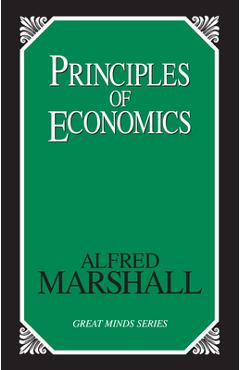
Principles of Economics - Alfred Marshall
89,89 lei112,36 lei-20%
Economisești 22,47 lei
✔ În stoc la libris.ro
Vezi oferta la libris.ro
Economisești 22,47 lei
✔ În stoc la libris.ro
Vezi oferta la libris.roALFRED MARSHALL, distinguished British economist, was born in London on July 26, 1842. His interest in economics arose out of his earlier studies of philosophy and mathematics. Following his tenure as first principal of University College, Bristol (1877-1881), Marshall taught at Cambridge University from 1885 to 1908, and lived in Cambridge for the remainder of his life. n Marshall's chief work is the Principles of Economics (1890; eighth edition 1920). One of the founders of the so-called neo-classical school, Marshall argued that the economy would run best if left on its own, and that the normal functioning of a market econ-omy leads to full employment. Though influenced by the ideas of John Stuart Mill, Marshall substantially altered Mill's frame of ref-erence: instead of analyzing how the production of goods and the distribution of income among different social classes affected, often dramatically, economic well-being, he studied price setting in a static context, focusing on small, gradual changes and the complex interrelations by which market balance, or equilibrium, is achieved. And while the earlier political economists Adam Smith and David Ricardo had identified labor as the force deter-mining the exchange value of goods, Marshall identified it as sat-isfaction of consumers' desires, or utility. n n Marshall's orderly Victorian picture of supply, demand, and price, particularly at a time when contemporary socialists and trade unions were challenging the status quo, c