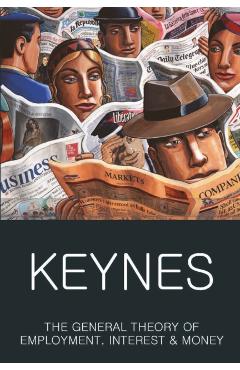
John Maynard Keynes
General Theory of Employment, Interest and Money
59,47 lei74,34 lei-20%
Economisești 14,87 lei
✔ În stoc la libris.ro
Vezi oferta la libris.ro
Economisești 14,87 lei
✔ În stoc la libris.ro
Vezi oferta la libris.roJohn Maynard Keynes (1883-1946) is perhaps the foremost economic n thinker of the twentieth century. On economic theory, he ranks with Adam n Smith and Karl Marx; and his impact on how economics was practiced, n from the Great Depression to the 1970s, was unmatched. n n n The General Theory of Employment, Interest and Money was n first published in 1936. But its ideas had been forming for decades as n a student at Cambridge, Keynes had written to a friend of his love for n 'Free Trade and free thought'. Keynes's limpid style, concise prose, and n vivid descriptions have helped to keep his ideas alive - as have the n novelty and clarity, at times even the ambiguity, of his macroeconomic n vision. He was troubled, above all, by high unemployment rates and large n disparities in wealth and income. Only by curbing both, he thought, n could individualism, `the most powerful instrument to better the n future', be safeguarded. The twenty-first century may yet prove him n right. n n n In The Economic Consequences of the Peace (1919), Keynes elegantly and acutely exposes the folly of imposing austerity on a defeated and struggling nation. n